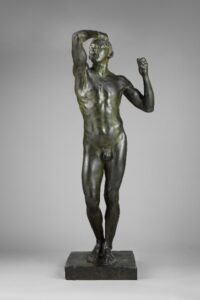
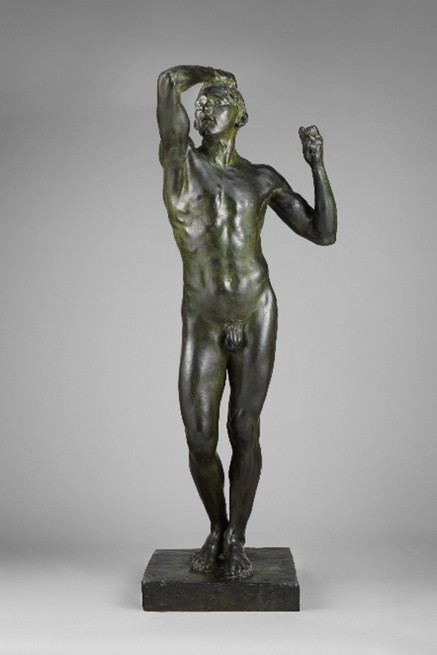
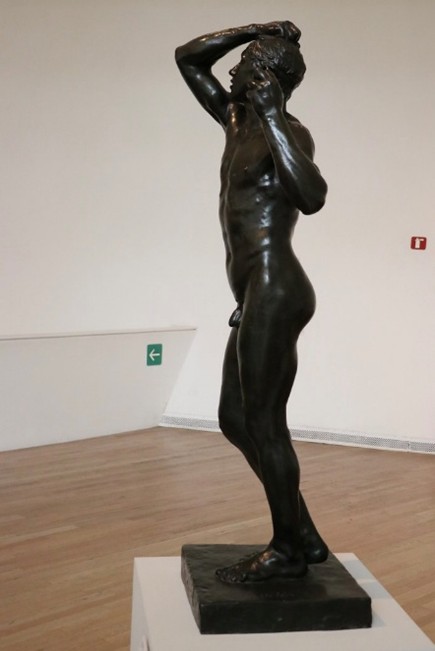
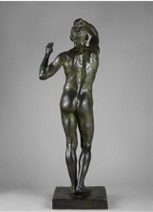
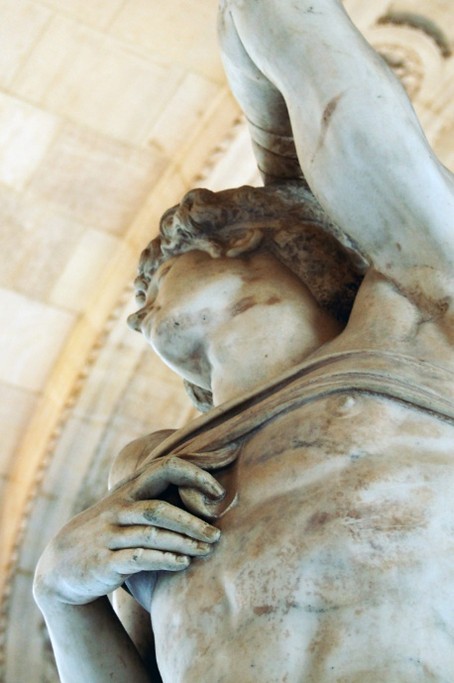
The three views of Rodin’s statue are of a bronze cast of the sculpture known as ‘The Age of Bronze’ by Auguste Rodin, whilst the fourth image is that of the upper part of Michaelangelo’s ‘Dying Slave’, the stance of which Rodin was echoing in his ‘Age of Bronze’ sculpture.
Clearly, the model in Rodin’s statue was striking the pose required by him for the realistic, naked, male detail of the end-result. Originally, the figure held a spear, but it was later stripped away by Rodin to separate the work from classical military Roman and Greek statues, as he wanted a more universal approach, for more people to be able to engage with the realistic detail of the statue. That definitely worked for me. I have seen, and largely passed-by, naked male statues conveying Roman military or Greek wrestling scenes. And whilst I might have admired this or that aspect of the sculpture, it was more symbolic of the age or context than anything else. That continued to be the case until I first saw the ‘Age of Bronze’ statue in Glasgow, in the Burrell collection, and it took my breath away.
For myself, I admire the incredible detail of the human anatomy, and the stance which conveys a physically fit human male of some considerable beauty. The clenched fists give a sense of physical power, alongside the displayed musculature and tendons as a result. The raised head and heel gives a sense of an individual who is self-assured and very aware of his own strength and physical fitness, knowing fully that these are all features that would make him very attractive to many.
Looking and stretching upwards and flexing muscles convey a large degree of confidence, and is in stark contrast to a very depressed individual who is often found stooping and head bowed, physically matching the state of mind. Admittedly, Rodin would have controlled that pose with his instructions for what he wished to create and convey, but the model could only have complied with that request if he already had both the body for it, but also the state of mind to carry it off.
From the side view, there is an enhanced sense of the stretch, with abdomen pulled in, as chest and shoulders are expanded. Whilst from the rear, the broad upper back and musculature runs down to a slimmer waist, and the legs also indicate the physical nature of the model’s daily existence, which was as a 22-year-old Belgian soldier, named Auguste Neyt.
I have described what I interpret this statue to be conveying to me, but that is most likely not what Rodin had intended, given that a spear was initially held and the title of the piece was originally ‘The Vanquished’. But then again, the spear was removed and the statue was retitled. And Rodin described the piece as “an exploration of humanity’s emergence into awareness”, aligning with the title’s reference to “the Bronze Age as a turning point in civilization”.
In our interaction with fellow humans, much of our communication is conveyed without words, partly through gestures, what the eyes are doing, the position of the head, but also how we stand or sit, which might convey anything from depression to anxiety, fear, anger, confidence, nervousness, stress, or just about any other emotion. On their own, the posture and gestures of a person can be misinterpreted, but when matched with voice pitch, tone, volume or style of language used, a fuller picture can be understood.
In the context of writing, given that we understand a lot from all these non-verbal signals, it would be useful to include a few of them to build a picture of the emotional state of any characters being described, but with, I would suggest, some caution and discretion to prevent a sense of ‘overkill’. It is good to be reminded of all of this, and I got more out of thinking about it than I had first envisaged.
Fraser